Sunday, 10 July 2011

Gothminister - Gothic Electronic Anthems (2003)

1. Gothic Anthem
2. Angel
3. The Holy One
4. Pray
5. The Possession
6. Devil
7. Shadows of Evil Sins
8. Hatred
9. March of the Dead
10. Wish
11. Post Ludium
12. Angel (Club version)


The Gothminister’s Debut – 7,8/10

The first album of Gothminister finds the man still having some kind of one-man-project with a message to all Goths in the world. He boasts heavily to be proud of what you are and to face the darkness within on this first album, which is appropriately entitled Gothic Electronic Anthems.

As you might expect, the album features a strong blend between electronic music and gothic rock. Gothminister’s use of a drum computer adds more to the techno-feeling throughout the album. Especially the first few tracks feature a heavy dance-beat with a strong offbeat computerized hi-hat to begin with. Strong trance-like synths bring an even more techno feel, but are often compromised with a heavy guitar riff underneath. Alexander Brem’s deep, low, crunchy voice makes it sound like another Rammstein-clone, but this act is surely bringing some new sounds to the table. As for the gothic elements; especially in the more quiet parts choirs attend to add more ambient backing vocals and of course the lyrics are all aimed at Goths all around the world. The booklet is filled with text about being proud of what you are and not letting anyone exclude you for being different. And they are told that interest in the dark and unknown will make you stronger than avoiding the unknown, which I guess is true. The fact that Brem calls himself the Gothminister would appeal to some, but would sound very arrogant to others, so this preaching to Goths perhaps doesn’t really appeal to non-Goths like myself, but I respect his vision Happiness in Darkness. It fits the music as well and at least this is not depressive dark metal.

The album kicks off with the peculiarly titled “Gothic Anthem” which kicks some serious ass with the heavy techno-beat underneath and the simple-but-effective guitars. The barbaric voice of Brem gives the song some extra kick a clean voice wouldn’t have been able to. “Angel” and “The Holy One” continue in the same vein, both being really worthwhile and some of the album’s finest tracks. “Pray” finds Brem going all-electronic with an even harder beat, which is a little too electronic for my taste. I find it to be one of Gothminister’s weaker tracks. “The Possession” blends nicely with “Devil”; a more upbeat track with another great offbeat industrial beat. This one has a really nice riff as well, which kind of makes up for the weak chorus. “Hatred” and “March of the Dead” both carry on with the goth/industrial blend, but lean more to the gothic side of the mixture. Then there are ballads. “Shadows of Evil Sins” feature a soft guitar plucking at the background with choirs performing and a dirty, evil whisper on the foreground. Since the song doesn’t really build to anything beautiful, it sounds more like Brem telling a ghost story over a backing track. The man has written way better ballads with “Wish” and “Post Ludium”. On “Wish” we have a beautiful chorus sung by female choirs and a definitive building within the song and a nice instrumental part in the middle. “Post Ludium” features these auto-tuned vocals like in “Pray”, but this time around it blends in nicely with the epic instrumentation. That’s a satisfactory disclosure to the album of anthems.

All in all, Gothic Electronic Anthems is not a bad debut album at all. While Gothminister presents himself as a teacher and preacher, he does know how to write good music with a good blend of gothic and industrial. The man has a vision with his music and that is respectable. This album is heavily recommended to fans of the goth/industrial genre.

Strongest tracks: “Gothic Anthem”, “The Holy One” and “Post Ludium”.
Weakest tracks: “Pray” and “Shadows of Evil Sins”.

Wednesday, 29 June 2011

Gothminister - Happiness in Darkness (2008)

1. Dusk Till Dawn
2. Darkside
3. Your Saviour
4. Freak
5. Sideshow
6. The Allmighty
7. Beauty After Midnight
8. Emperor
9. Mammoth
10. Thriller


Gothic Electronic Metal – 8,6/10

Though this album is by no means the first Gothminister effort and therefore not at all the first album to combine trance-infused industrial with a dark gothic flavour, it is by far the best I ever heard. The band and the genre are very much underground now about ten years after their peak, but there’s still some high-quality music produced here.

The band, usually dressed up like any gothic band, with white faces and dark accents, has blended the pumping industrial with gothic on this album better than ever. There’s a great balance between danceable tracks and metal tracks, which means more diversity and that is mostly what makes or breaks an industrial record, although I must admit vocalist Bjørn Alexander Brem’s low, crunchy voice is a love-it-or-hate-it factor. Opener “Dusk Till Dawn” reintroduces the trademark Gothminister sound with trance-rhythms covered with a heavy metal guitar to make the metalheads approve it as well. The explosive sing-along chorus makes a fine and memorable opener to the band’s finest album yet. Lead single “Darkside” totally differs from that formula and sounds more like a radio-friendly but very catchy single with a stronger gothic ambience. It is however the song that got me into Gothminister and still stands tall with its amazing chorus and climax. We get back to the pumping industrial with “Your Saviour”, which plods along nicely in the shadow of “Dusk Till Dawn”, whereas “Freak” sits strongly in the shadow of “Darkside”, both sharing a similar structure and atmosphere. “Sideshow” finds good compromise between the four tracks and has really commanding verses with a chaotic and symphonic chorus and features, once again, a great climax in the bridge.

The second half of the album is a lot more experimental for Gothminister’s customs. “The Allmighty” is a resting point on the album with a small choir of female voices taking care of all the vocals, which they do very nicely. Even better is the transition to “Beauty After Midnight”, which amplifies the contrast between the nice and peaceful and the once again pumping trance-like fury. This is my favourite song of the album as it features once again a great danceable rhythm but soon turns into pure metal fury in the verses. The chorus is good, but I feel it could’ve been better as Brem doesn’t really sing as powerful here as he does on practically every other song he recorded, which is a shame. We are given an electronic ballad with “Emperor”, which starts off with a peaceful melodic theme before it goes into the hypnotic electronic beat that lays the foundation for the verses. The melodic intro is eventually used as a bridge, which is the intro to a very powerful chorus, thus making this one of the album’s highlights as well. And before we know it we have arrived at the album closer “Mammoth”, which has a much more conventional industrial vibe to it, but still carries that Gothminister sound and an even epic ambience in the chorus. It also features this powerful line in the chorus: ‘the Minister will watch over your soul’. It was a rather short album, perhaps due to lack of material, but clearly the band saw this too and recorded a cover of Michael Jackson’s “Thriller” and included it on the album. This song is perfect for the band to convert it to their sound, but I wouldn’t have missed it.

In the end I am more than thrilled for having met the music of Gothminister. It is by far one of the more original and inventive industrial acts today. I highly recommend the band and their sound to anyone in for danceable metal and gothic looks.

Strongest moments: “Darkside”, “Beauty After Midnight” and “Emperor”.

Thursday, 2 June 2011

System of a Down - Mezmerize (2005)

1. Soldier Side (intro)
2. B.Y.O.B.
3. Revenga
4. Cigaro
5. Radio/Video
6. This Cocaine Makes Me Feel Like I'm On This Song
7. Violent Pornography
8. Question!
9. Sad Statue
10. Old School Hollywood
11. Lost in Hollywood


A Few Changes Here and There – 7,7/10

And here we have another album by nu-metal giants System of a Down. Will they have changed their sound now? Toxicity and Steal This Album! looked a lot alike in terms of sound and production. I’m glad to say Mezmerize shows progress in the band’s writing process. Where the first three albums were mainly focusing on head banging and primitive riffs that were heavy is hell, Mezmerize focuses on other things. Read on if you’re interested.

Let me begin with informing you that either the band collectively decided to try something new or that Daron Malakian’s arrogance has grown enormously. Serj Tankian has to share his lead vocal duties with main songwriter and guitarist Daron Malakian, which is good for a change, but Tankian remains a way better vocalist. Malakian has a very sharp voice and it doesn’t sound cool at all. He sounds wacky and like a joker. Which brings us to the next new element. There is way more emphasis on wacky songs and jokes. Of course, there wasn’t much seriousness about “Deer Dance” or “Prison Song”, but they showed the band being original and raw. It’s beginning to sound a little forced here, but since it’s System, I’ll cut them some slack. The production has been altered as well, with the band sounding really tight now. Toxicity sounded very loose, raw and primitively spontaneous. Mezmerize sounds more contemporary in terms of sound, very tight and still spontaneous, but also less heavy. It might also be noticed that Tankian no longer shouts primitively. He now is a civilized vocalist with vocal techniques and range. Actually the new sound is quite nice at times, especially with the high-quality material the disc is filled with.

True album opener is “B.Y.O.B.”; a heavy, wacky track that goes from aggressive verses to a dance-vibe in the chorus. It’s still amazing what these guys can do in a short track of three minutes. They blow every minute full of energy, literally jump from theme to theme, make sure every second is stuffed with sound and then put it on an album. And the funny thing is it doesn’t get old. Never. One thing that will be noticed is the more radio-friendly choruses on the songs like “Radio/Video”, “Revenga”, “Violent Pornography” and “Sad Statue”. While the riffs are still brutal and heavy, the melodies are increasingly sweeter and soft. Especially when sung by Malakian. Notable tracks include the two album closers. “Old School Hollywood” is surprisingly synthy, which is a fresh sound on the album, while “Lost in Hollywood” is not a Rainbow cover, but a true attempt at an epic album-closer. Maybe if Serj Tankian would have sung it, it could have been a classic.

Well, I’m done. I have nothing more to say. It’s basically System doing what System does, with the few changes I indicated. If you love the band and their sound, you will still love this record.

Strongest tracks: “Cigaro”, “This Cocaine Makes Me Feel Like I’m On This Song”, “Sad Statue” and “Old School Hollywood”.

Wintersun - Wintersun (2004)

1. Beyond the Dark Sun
2. Winter Madness
3. Sleeping Stars
4. Battle Against Time
5. Death and the Healing
6. Starchild
7. Beautiful Death
8. Sadness and Hate


The Epic Definition of Scandinavian Metal – 10/10

It’s not very often that I reward an album with a perfect score, but Wintersun’s debut album really earns it. As we’re all still waiting for over seven years for the second album to be on the way, just one glance at this record reminds us why the hell we still hope for that second album to come out. But most of all we want to know how the hell Jari Mäenpää can top this masterpiece of epic power metal.

Nothing but good words from me about this record. From the opening track “Beyond the Dark Sun” on you will be bombarded with epic chord progressions, strong melodies straight from the gut and in-your-face heaviness combined with virtuosic solos. Mr. Mäenpää sorted his songs from short to long and released them in exactly that form and surprisingly the winning formula of variation coincides. After the fast, epic introduction of “Beyond the Dark Sun” we get to know the heavy side of Mäenpää and the true nature of drummer Kai Hahto as furious blastbeats dominate the track, ironically topped with a melodic, icy ambience. Mäenpää’s screams sound very convincing and full of emotion; not something I often experience when hearing screams, growls or grunts. The great solo in the middle also deserves a little mention. From fast and melodic to heavy and aggressive to the third song of the album: “Sleeping Stars”. As the title might suggest this song tends to be an epic ballad-ish type of song. Given that Mäenpää still uses his screams might indicate this is not truly a ballad, but we also get to hear him sing here and he does it alright. Too bad his singing voice is mixed a little to the background so it doesn’t fully come to its right. With these three first tracks, we’ve seen the many-sidedness of Wintersun and the next few tracks will blend these elements to longer tracks with worthy mentions being the epic ballad “Death and the Healing”, the progressive “Starchild”, the blackened “Beautiful Death” and the beautiful album closer “Sadness and Hate”. I could write another paragraph to describe each and every one of them, but it will contain the word ‘epic’ a little too many times.

Instead, I’ll focus upon what makes this album thrive so much. The concept of a dark sun, a winter sun, is nothing new within the Scandinavian metal acts, but I have rarely seen an album so obsessed by eternal winter, by epic darkness, that it actually brings a melancholic element to the band. Within this aggressive record of despair, grief, anger and regret there’s a very strong longing for light; a desperate cry to reach the warm sun, which is a source of positive energy. I think it might very well be a feeling familiar to many inhabitants of northern Scandinavia and other countries close to the North Pole. For me, someone who doesn’t know the effect of the dark winter sun in my country, the feeling is still familiar, but not the literal phenomenon. On pictures it always is a beautiful sight to see such an image, but in reality, such a long period of darkness affects your mood. This album totally captures that mood. Its melodies and sounds are beautiful, but in reality Mäenpää and Hahto want to make us feel like they do and the lyrics are as dark as the night. I think it’s a really thrilling concept and they did a good job bringing that concept to a credible and terrific end.

In short, if you want an album that not only sounds original, but also has a thrilling concept combined with excellent music, executed by virtuosos, this album should be on your ‘to-get’-list. Today, almost five years after I discovered this album, I still listen to it and enjoy it to the full. I have different favourites every time I hear it though.

Strongest moments: “Winter Madness”, “Death and the Healing” and “Beautiful Death”.

Saturday, 14 May 2011

Earth & Fire - Song of the Marching Children (1971)

1. Carnaval of the Animals
2. Ebbtide
3. Storm and Thunder
4. In the Mountains
5. Song of the Marching Children


Makes me Proud to be Dutch – 8,8/10

If I look at the music artists from The Netherlands, I’m not quite a patriot. Most of what I like to listen to comes from abroad. But there are a handful of Dutch bands or acts that really makes me proud to share their nationality. Of course, Kayak is one, but Earth & Fire certainly is too. Or at least early E&F… I’m not a fan of their post-1975 works. I know I’m a little late with discovering a masterpiece from 1971, but good quality prog never gets old, which only proves how well this record has stood the test of time.

It’s only been a year after their debut album, but you can already see changes in musical style… for the better. There’s a big emphasis on the building of the songs and there’s a strong symphonic edge to the album. Big orchestra’s and old synthesizers often take an important role in texturing the songs, but not as much as Gerard Koerts’ little organ, which leads every track to a satisfying end. It’s also notable how Van de Kleij’s drums sound very powerful and bombastic, which brings me to another powerful side of the album: its production; it’s easily one of the best productions possible in 1971. Every instrument sounds clear, powerful and authentic in the way it’s supposed to sound. And then we have Jerney Kaagman providing lead vocals to the music; she sounds quite odd, but after a few listens she really fits to the music. Her voice is technically not the best you’ll find, but she certainly has the power to bring Song of the Marching Children to a more than satisfying end.

The album opens with the cheery “Carnaval of the Animals”; it has a theme you’d hear through merry-go-round speakers on a fancy fair. It is on this song that Kaagman makes a somewhat weird first impression; a soft and subtle voice on the verses, but a hard and shrill falsetto at the chorus. It is mostly her voice why I think this song is the weakest on the album. But don’t worry, it’ll all go top notch from here. “Ebbtide” is beautifully peaceful with Chris Koerts’ vibrato guitars and the softer side of Kaagman’s voice, however, the best is yet to come. “Storm and Thunder” enters with a strong but calm organ solo by Gerard Koerts, before starting a gentle verse part. But don’t be fooled, for hell breaks loose afterwards in a powerful, bombastic part that finishes this song off in epic mode. Kaagman proves she can sing powerful in her higher regions, as long as she doesn’t go falsetto. The band showcases their instrumental magic on the magnificent “In The Mountains”, which features a brilliant shifting of lead patterns by organ and guitar. Then there is the magnum opus of the album: “Song of the Marching Children”; an eighteen-minute piece with many different faces. It starts off with a calm intro tune, but quickly turns into the symphonic bombastic verses and chorus of the second part, before going completely off the chart. With that I mean the song falls silent and begins with completely different themes. They can be forgiven for merging it into one track by adding part A to G on the track list description. The other themes are adventurous, but the song won’t reach the quality of the first few parts again. The end of the march-like snare-hits does give a possibly desired feel at the end and making it fade out slowly automatically makes you silent for a while.

The album is a true adventure and gets better with every listen. It screams masterpiece at every note. I strongly recommend this record to every fan of early progressive and/or symphonic rock. As for me, I’ll probably be off to listen to other Earth & Fire albums.

Strongest tracks: “Storm and Thunder” and “In the Mountains”.

Sunday, 24 April 2011

Killing Joke - What's THIS for... (1981)

1. The Fall of Because
2. Tension
3. Unspeakable
4. Butcher
5. Follow the Leaders
6. Madness
7. Who Told You How?
8. Exit


Well… what is this for? – 7,2/10

For the real Killing Jokers! It’s the year of 1981 and there are a bunch of frustrated adolescents with a record deal and a debut album just released. They’re about to release their second LP and are confident about putting their frustration in that record. Yet, they do not want to get enormously heavy and/or turn their sophomore album into metal or hard rock. How did they do this? In a way only Killing Joke can.

Killing Joke is a very fascinating band at every stage of their development. Especially the early albums in the original lineup, including this one, share a very interesting atmosphere, mixing anger, frustration, disappointment and pure, primitive emotions with the hypnotic, entrancing rhythms of tribal drums, 80s dance-beats and hooligan-like vocals on top. They emit the all-for-one-attitude. Top that of with Geordie’s high, soaring guitar riffs and Youth’s independent bass lines and you have a very intriguing result. What I find really well done was the inclusion on this record of frustration and anger, without making the music too heavy and hard. We are taken into a trance by the monotonous, tribal drums of Big Paul Ferguson while being brainwashed by the rebellion-lyrics of Jaz Coleman, whose vocals are mixed surprisingly to the background of the music. As if he is not the main focus of the album. While I first disliked it, it actually added to the atmosphere of hypnotism. After the classic debut record this album really was a lot less accessible partly due to the vocal mix. Other reasons are probably the lack of hit singles.

But a lack of hit singles has never stopped us from liking a record before. “The Fall of Because” is threatening throughout, but never bursts into the explosions you’d expect it to. “Tension” showcases a catchy drum rhythm, very similar to Queen’s “Party” of their 1989 album The Miracle. Coincidence? Anyway, the ambience is similar to the opening track and never bursts out into that aggression you just feel there is. Especially when Coleman tells us that ‘the tension builds’. But then comes “Unspeakable”; a song lead entirely by the tribal rhythm our dearest Mr. Ferguson brings us. The riff is just furious here and the chorus also has difficulties containing the fury of the band. But then “Butcher” takes a few steps back. Instead of finishing what they started, they backfire before the anger really comes out. It’s still a threatening track though, but quite a relief after “Unspeakable”. Back to the concept we go with “Follow the Leaders”; a danceable and catchy song that certainly doesn’t have the threat of the first few tracks, but does contain the magic of the previous moments. “Madness” is one of my least favorite songs of What THIS for… and it sounds like it’s a leftover from the debut album for good reason. It peaks almost at eight minutes and is monotonous and totally unadventurous and especially throws away all the frustration built up by the previous few tracks. The meaningless instrumental “Who Told You How?” is followed by “Exit”, which closes the record at a high level, re-establishing the threat and reminding us of the Killing Joke.

This album is a fine record, but not one of Killing Joke’s finest. They are clearly frustrated and found a unique way to let us know, but the fact that there’s a constant threat, a constant tension that builds, builds and builds but never unleashes the fury, never reaches its peak is quite unsatisfying. The inclusion of a few mediocre tracks even more diminishes the quality of the listening experience. This is an album I’d only recommend to the real Killing Jokers, to the die-hard fans.

Strongest tracks: “The Fall of Because”, “Tension”, “Unspeakable” and “Follow the Leaders”.
Weakest tracks: “Madness”.

Sunday, 3 April 2011

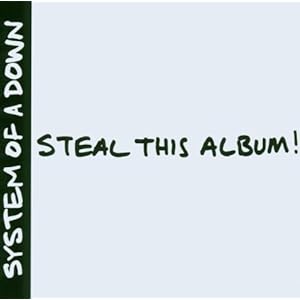
System of a Down - Steal This Album! (2002)

1. Chic 'n Stu
2. Innervision
3. Bubbles
4. Boom!
5. Nüguns
6. A.D.D.
7. Mr. Jack
8. I-E-A-I-A-I-O
9. 36
10. Pictures
11. Highway Song
12. F**k the System
13. Ego Brain
14. Thetawaves
15. Roulette
16. Streamline

Turn in the Thieves – 7,8/10

The follow-up to System of a Down’s breakthrough record Toxicity had an odd story to accompany its unique packaging, which was to mimic a burned disc. I won’t bother you with that tale, but I can assure you those who stole this record have now sinned even worse for Steal This Album! turns out even better than its predecessor. Since it was not supported by a tour, some people believe this to be a bunch of leftovers from the Toxicity sessions. It’s partly agreeable, for this album is not very coherent, but it’s mostly very disagreeable since this record contains some of the finest System tunes you’ll ever hear.

Demos of this album once surfed on the net as Toxicity II and that still left its marks on the final album. It literally picks up where Toxicity finished. It’s equally barbaric, primitive and heavy, yet also mean, political and thought out. Even the structure of the album shows similarity. Opener “Chic ‘n Stu” is as wacky and chaotic as “Prison Song” and “Innervision”, “Bubbles” and “Boom!” show equal amount of barbaric metal as “Needles”, “Deer Dance” and “Jet Pilot”. Then “Nüguns” parallels with “X”, and so on. If you’d mix up the two records, you wouldn’t tell which song is from which album production- and sound-wise. It really looks like they were trying to get that sound they got famous with one year ago.

The main difference is the amount of tracks on this record, which is a lot and which does mean a higher amount of filler tracks. Tracks like “Mr. Jack”, “Pictures”, “Highway Song” or “Thetawaves”, but also the very short “36” just don’t add a thing to the record and become sources of irritation for your ears. That is quite a lot. Luckily the other material is very strong and original. In particular the politically aggressive “A.D.D.” is very powerful, as well as the anthem “I-E-A-I-A-I-O”. Towards the end the songs start becoming a bit mellower but also a little flash-forward to the Mezmerize/Hypnotize records is being given in tracks like “Ego Brain” or “Streamline” where they tend to focus more on song structure and melody rather than the barbaric power of “A.D.D.”. What also adds to the flash-forward is the increasing presence of Daron Malakian’s voice next to Serj Tankian’s, which blend uniquely if you can bear Malakian’s sharp voice for so long. Near the end I find the wacky “F**k the System” and the ballad “Roulette” to be the highlights.

In the end, Steal This Album! may well be System of a Down’s finest moment if you reduce the amount of tracks to twelve. I recommend, however, not to steal this album but to buy in your local store if you love System of a Down or nu-metal.

Strongest tracks: “Chic ‘n Stu”, “A.D.D.”, “I-E-A-I-A-I-O” and “Roulette”.
Weakest tracks: “Pictures”, “Highway Song” and “Mr. Jack”.